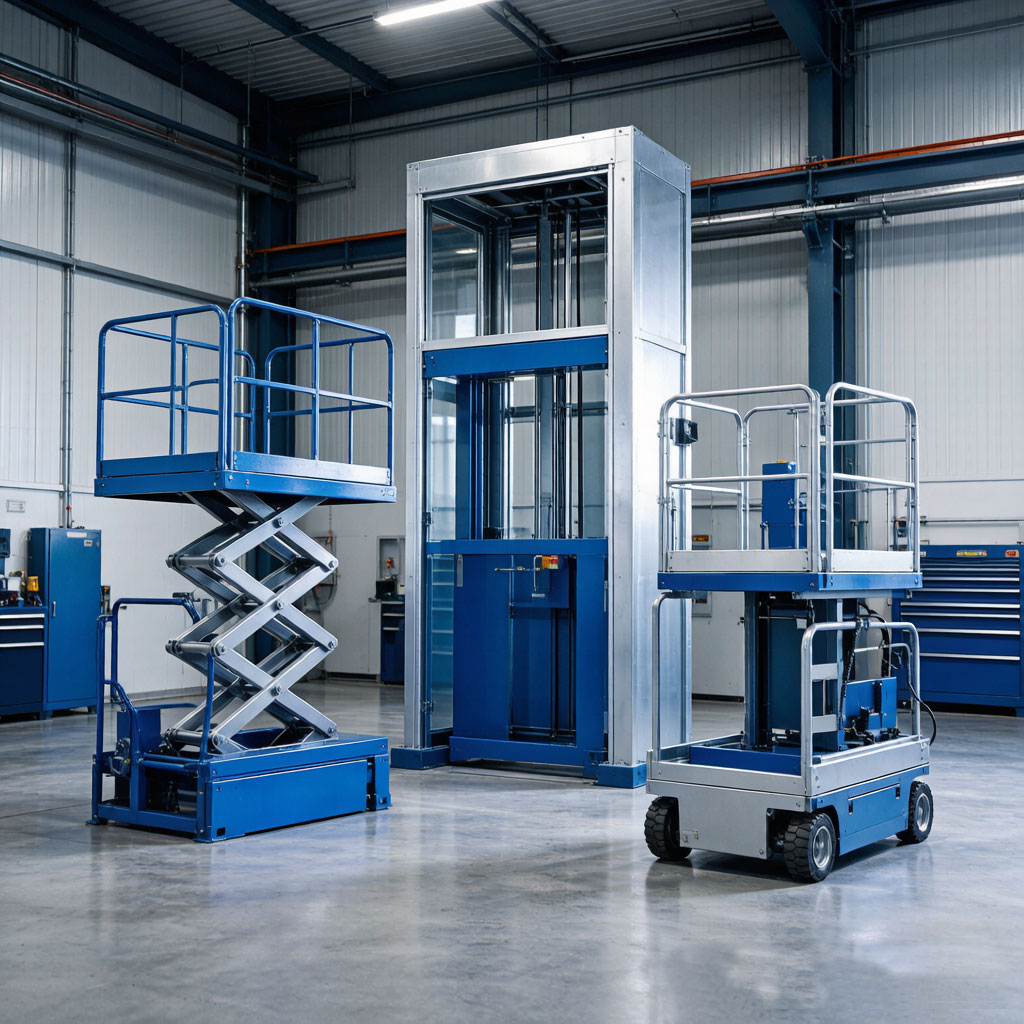
Compare hydraulic freight elevators and electric freight elevators from five dimensions: driving mode, load capacity, operating speed, installation conditions, and maintenance costs to help factories and warehouses choose the most suitable cargo equipment.
Freight elevators are essential vertical transportation equipment in factories, warehouses, and logistics centers. Currently, the mainstream industrial freight elevators on the market are divided into two categories: hydraulic freight elevators and electric freight elevators (traction freight elevators). Many buyers are easily confused when choosing. This article provides a comparative analysis from five core dimensions to help you make the right choice.
1. Comparison of driving methods
Hydraulic freight elevatorA hydraulic pump station is used to drive the hydraulic cylinder, and the lifting or lowering is achieved by jacking or side jacking. It has a simple structure and strong carrying capacity. The load range is usually 1-50 tons, and some customized models can reach 100 tons.
Electric freight elevator (traction freight elevator)It adopts traction motor + steel wire rope/steel belt drive, and realizes lifting and lowering through counterweight balance, making the operation smoother and faster. The load range is usually 1-10 tons, and the speed can reach 0.5-1.0m/s.
2. Comparison of installation conditions
| Comparative item | Hydraulic freight elevator | Electric freight elevator |
|---|---|---|
| Shaft requirements | No special shaft is required, steel structure support can be used | Requires dedicated shaft and machine room |
| Civil renovation | Small renovation, suitable for retrofitting old factory buildings | Large renovation, suitable for new factory buildings |
| Installation cycle | 7-15 days | 15-30 days |
| Covered area | smaller | Larger (needs counterweight space) |
3. Comparison of operating performance
Hydraulic freight elevator: Smooth lifting and high positioning accuracy (±5mm), suitable for frequent starts and stops, heavy-duty short-distance transportation. The operating speed is 0.1-0.3m/s, which is not suitable for high-speed operation.
Electric freight elevator: It has fast running speed (0.5-1.0m/s) and is suitable for high-rise transportation (above 6 floors), but the start-stop acceleration is large, and the positioning accuracy under heavy load is slightly lower than that of the hydraulic freight elevator.
4. Maintenance cost comparison
The maintenance of hydraulic freight elevators mainly focuses on the hydraulic system (cylinders, oil pipes, seals). The hydraulic oil can be replaced regularly. The annual maintenance cost is about 2,000-5,000 yuan. Electric freight elevators require maintenance of traction machines, wire ropes, guide rails, etc. The annual maintenance cost is about 5,000-10,000 yuan. In the long run, the overall maintenance cost of hydraulic freight elevators is lower.
5. Suggestions for selection
Recommended scenarios for choosing a hydraulic freight elevator:
- Large load capacity requirement (more than 5 tons)
- The floor is below 6 floors
- Renovation and addition of old factory building without dedicated shaft
- Limited budget, pursuing cost-effectiveness
Recommended scenarios for choosing an electric freight elevator:
- The floors are above 6 floors and require high-speed operation.
- When building a new factory, you can plan the shaft in advance
- Extremely high requirements for smooth operation (such as transportation of precision instruments)
(Data source: GB/T 10058-2009 "Technical Conditions for Elevators", GB 50017-2017 "Steel Structure Design Standards")