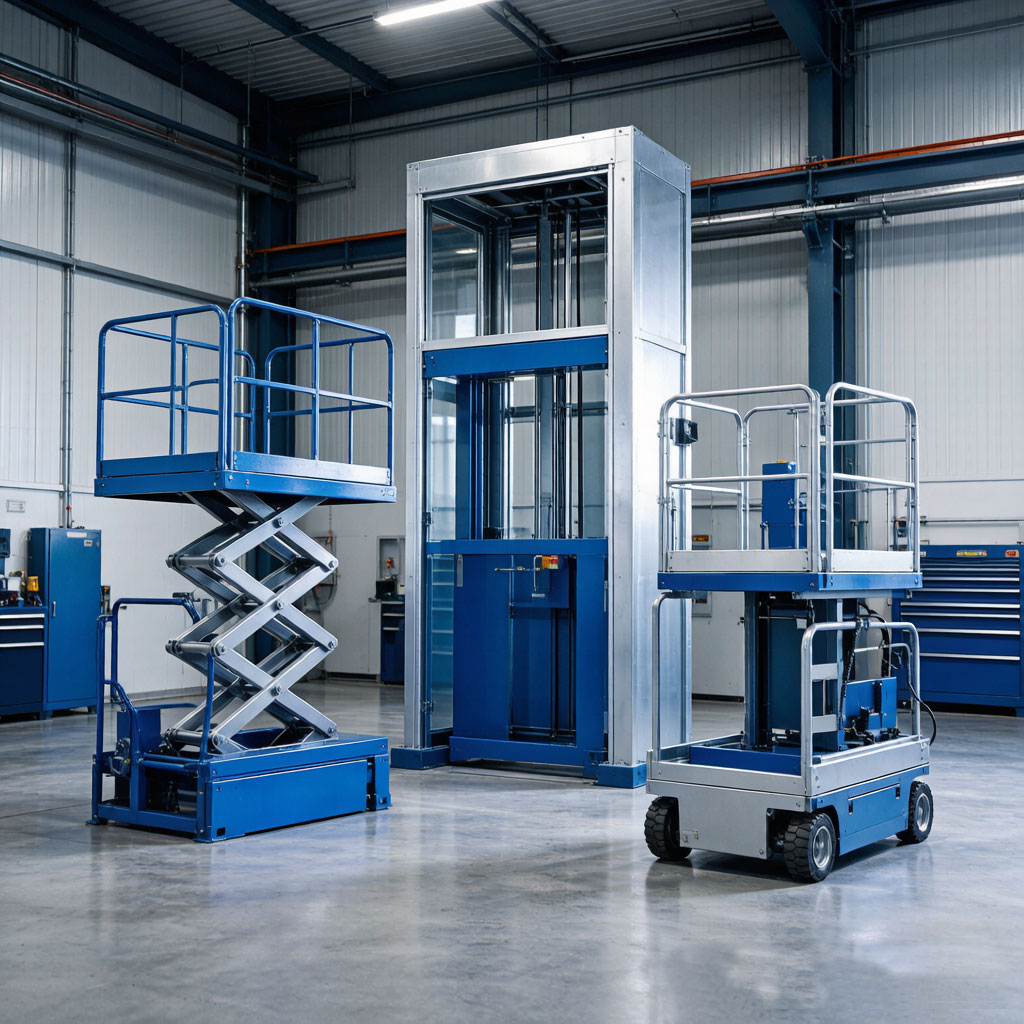
Detailed comparison of the structural principles, applicable scenarios, load-carrying capacity, and installation requirements of rail-type hydraulic lifting platforms and scissor lifts to help companies select models based on actual needs.
In the field of industrial lifting equipment, rail-type hydraulic lifting platforms and scissor lifts are the two most common models. Many purchasers are not clear enough about the difference between the two, resulting in improper selection. This article conducts a systematic comparison from three dimensions: structural principles, applicable scenarios, and performance parameters to help you make a reasonable choice.
1. Differences in structural principles
Guide rail hydraulic lifting platformIt is driven by a hydraulic cylinder and the lifting movement is realized through guide rail guidance. The platform runs up and down along the guide rails fixed on the building or steel structure, with stable structure and high positioning accuracy. Its core features are: hydraulic power + guide rail guidance, suitable for vertical transportation of goods in fixed positions.
scissor liftIt adopts a scissor arm structure and uses a hydraulic cylinder to push the scissor arms to expand or contract to achieve lifting. Scissor type can be divided into two types: mobile type and fixed type. The mobile type is equipped with running wheels and can be flexibly moved; the fixed type is fixed and used at a designated location. Its core features are: scissor arm structure + mobility, suitable for multi-point operations or scenes that require movement.
2. Comparison of applicable scenarios
| Comparative item | Guide rail hydraulic lifting platform | scissor lift |
|---|---|---|
| best use | Fixed position vertical transportation of goods | Multi-site operations, maintenance, loading and unloading |
| Typical scenario | Freight elevators between factory floors and transportation between warehouse shelves | Workshop maintenance, warehouse handling, building decoration |
| Mobility | Fixed installation, not removable | Mobile and flexible |
| Load capacity | 1-50 tons | 0.5-50 tons |
| Lifting height | Up to 30 meters | The maximum height is 14 meters for mobile type and 20 meters for fixed type. |
| Countertop size | Can be customized according to needs | The mobile type is smaller, the fixed type can be customized |
3. Selection suggestions
Situations for choosing rail-type hydraulic lifting platform:
- It is necessary to realize vertical transportation of goods at fixed locations (such as between floors and shelves)
- Large load capacity requirements (more than 5 tons)
- High lifting height (above 10 meters)
- Requires higher positioning accuracy
- No need to move the device frequently
When to choose a scissor lift:
- Need to work in multiple locations (such as maintenance in different areas of the warehouse)
- Medium load capacity (less than 5 tons)
- The lifting height is within 14 meters
- Requires equipment to be portable and flexibly deployed
- Limited budget, pursuing cost-effectiveness
4. Cost comparison
Under the same load and height conditions, the purchase cost of a scissor lift is usually lower than that of a rail-type hydraulic lifting platform. However, the service life of the rail-type hydraulic lifting platform is longer (15-20 years), and the long-term comprehensive cost may be lower. It is recommended that purchasers comprehensively consider factors such as service life, maintenance frequency, operating efficiency, etc. to conduct a full life cycle cost assessment.
(Reference standards: GB/T 3811-2008 "Code for Crane Design", JB/T 9229-2013 "Scissor Lift Platform")